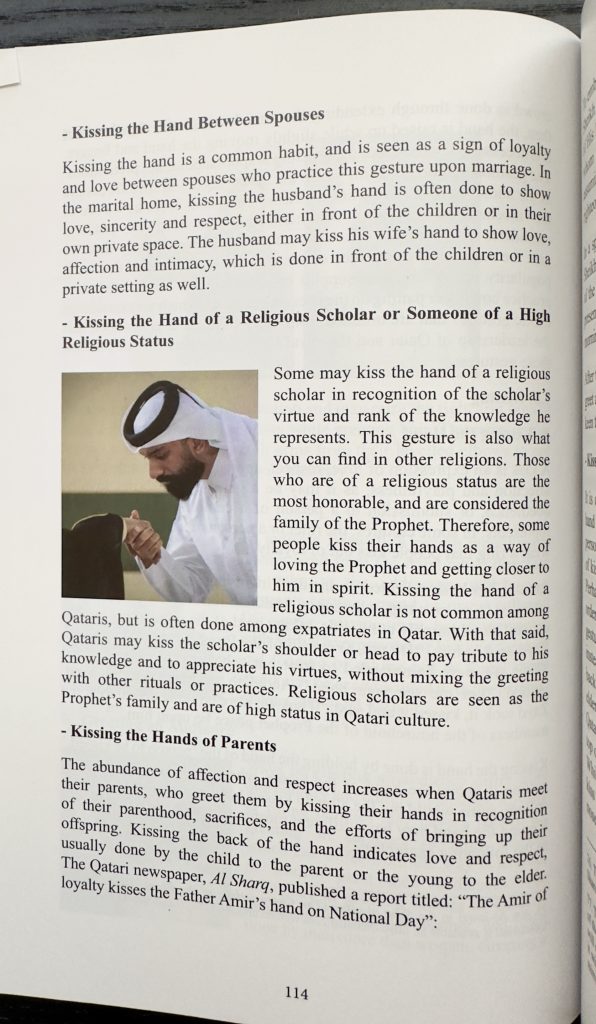
As second language educators, we understand that body language and cultural signs are essential for effective communication. And we also know that they are often challenging to interpret, because nonverbal cues carry significant cultural meanings that are implicit.
Signs and Gestures: Nonverbal Communication in the Qatari Culture (2022), authored by my colleague Muntasir Al-Hamad, is a unique book in the field, and it extends beyond cultural signs and gestures to explore anthropology and social norms within Qatari and broader Arab societies.
The book is comprehensive and covers a wide range of gestures and cultural signs that range from clothing to greetings, driving, facial expressions, and body movements. I didn’t count them, but there are probably 200-300 gestures and their corresponding images. And I confess that I smiled at many of them (some of my favorite sections are in the images posted here).
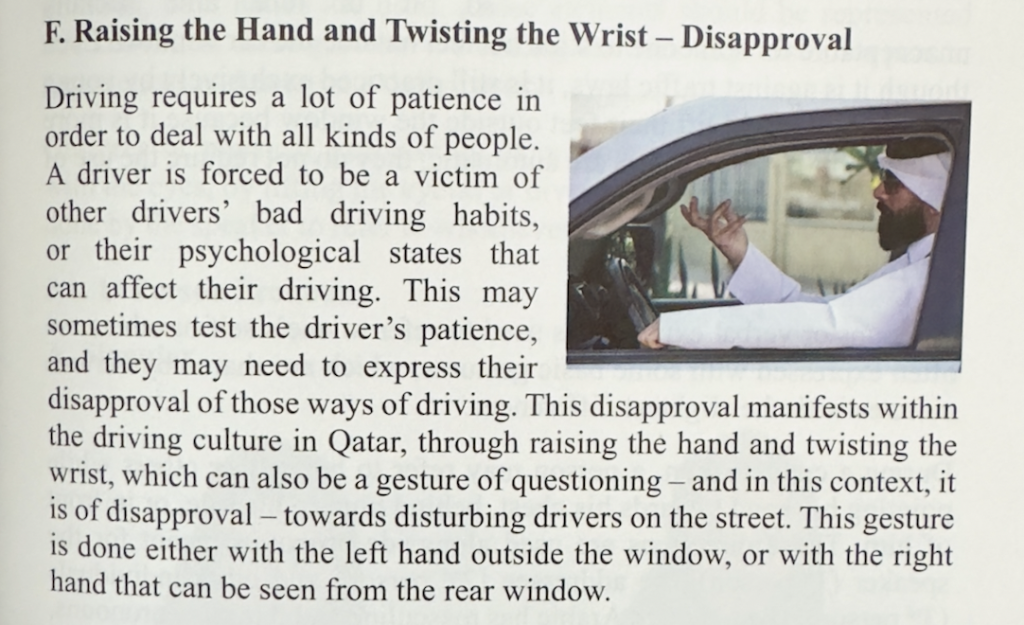 I found the book particularly enjoyable due to its excellent comparisons between Qatari signs and gestures and some Western equivalents. This comparative approach was a standout feature for me. Often, students may dismiss Arab cultural symbols as strange or extravagant, when a bit of self-reflection on their own culture (and teachers’ guidance) could foster intercultural competence and offer a better understanding.
In the foreword, Prof. George Grigori emphasizes that integrating into Arab society requires more than verbal skills; a point that teachers of Arabic as a second language should note.
One suggestion for future editions would be to include clearer pictures depicting women, because in some cases the black attire blends with a black background and makes it hard to distinguish the gesture. More detailed images of women’s clothing would also be beneficial, as most current images focus on men’s clothing symbols.
It is evident that the effort invested in producing this valuable resource was huge, and I encourage my colleagues to incorporate insights from the book into their Arabic language classes and curricula.
This review is for the English translation of the original, published in Arabic in 2019.
(What resources do you use to teach non-verbal communication in your Arabic classes? Tell us here)